
ASAMS was engaged by a global engineering and asset management organisation to investigate severe corrosion affecting multiple kiln pipe sections operating at unusually high temperatures (>800°C). We delivered a failure investigation combining destructive testing with external chemical analysis, XRD, SEM, and EDX. The programme was completed within seven weeks, identifying the most likely damage mechanisms and supporting mitigation planning.

Results & Findings
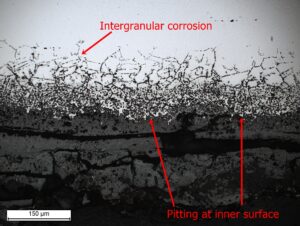
Interpretation & Root Cause
The investigation indicated that prolonged exposure to unusually high operating temperatures promoted sensitisation and creep related degradation, increasing susceptibility to intergranular corrosion and embrittlement. Findings also suggested a contribution from high temperature coal related corrosion mechanisms, including reducing sulphidation and metal dusting, with the potential for local nickel sulphide related liquid metal embrittlement. Conclusions are based on laboratory examination of the supplied sections; wider operating conditions were not directly assessed.

Key Outcomes & Client Benefits
ASAMS provided a clear, evidence-based view of kiln condition and the most likely damage mechanisms, enabling informed decisions on repair strategy, mitigation options and future operation. Findings were issued in a single, clear report to reduce uncertainty and support confident asset management planning.
Services Provided by ASAMS
Need certainty on a materials or failure issue?
ASAMS provides accredited metallurgical, mechanical, and corrosion testing to turn complex failures into clear, actionable decisions. Speak to a metallurgist today about your investigation or qualification requirements.