Have you ever wondered why certain metals behave differently in the cold compared to room temperature? At specific temperatures, the mechanical properties of some materials can change significantly, turning a tough material into a brittle one. This phenomenon is known as the ductile-to-brittle transition. This article explains the mechanism behind it and how it differs between materials.
Ductile and brittle fracture
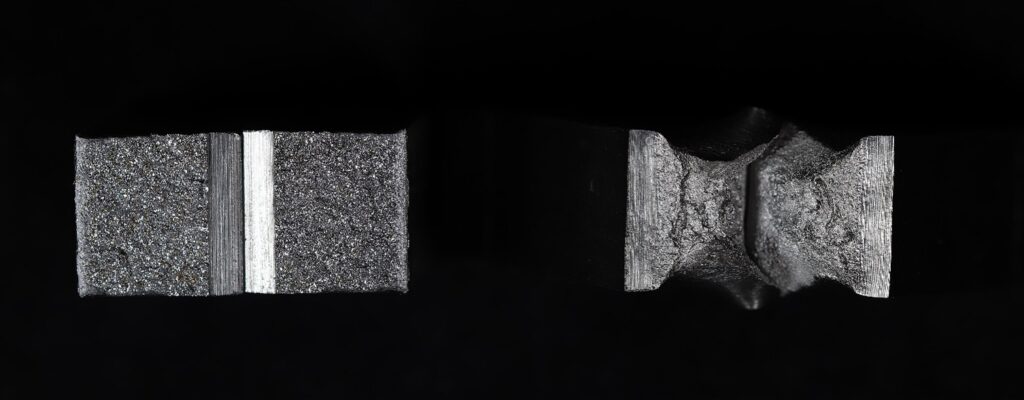
Fractures can be classified as either ductile or brittle. Ductile fracture absorbs a large amount of energy and is normally accompanied by visible plastic (permanent) deformation of the sample, which gives warning before failure. Brittle fracture requires far less energy and propagates much faster, with little or no warning, and its fracture surfaces appear flatter and more granular. For most applications of metallic materials, ductile failure is therefore desired.
However, some materials change from ductile to brittle behaviour as the temperature falls. This usually happens over a temperature range rather than at a single point, and the temperature at which it occurs is known as the Ductile-to-Brittle Transition Temperature, or DBTT. The change is reversible, because warming the material restores its toughness, but a brittle failure in service happens suddenly and cannot be undone.
How is DBTT measured?
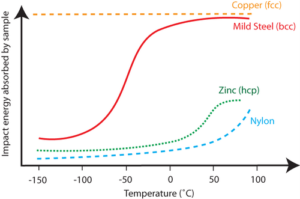
DBTT is most commonly measured using the Charpy impact test, as in the specimens pictured above. A notched bar is struck by a swinging pendulum and the energy absorbed in breaking it is recorded. Repeating the test over a range of temperatures produces a curve like the ones in Fig. 1. The steep section is the transition region, and the flat regions either side are known as the upper shelf (ductile) and lower shelf (brittle). The graph below compares four materials.
Why do some materials transition and others don’t?
The answer lies largely in crystal structure. In body-centred cubic (BCC) metals such as mild steel, the stress needed to move dislocations (the line defects that allow a crystal to deform plastically) rises sharply as the temperature falls. Below a certain temperature it becomes easier for a crack to cleave the material than for the metal to yield, and it fails in a brittle manner. In face-centred cubic (FCC) metals, dislocation movement is far less sensitive to temperature, so they remain ductile.
As shown in Fig. 1, mild steel, a low-carbon BCC steel, shows the classic behaviour. Its absorbed energy drops steeply from a high upper shelf to a low lower shelf over a range of roughly −100°C to 0°C, centred at around −50°C. The exact position depends on composition and processing. Copper, which has a face-centred cubic (FCC) atomic structure, does not exhibit any DBTT behaviour through a wide range of temperatures. Austenitic stainless steels, such as 316, are also FCC materials and exhibit no DBTT, which is why they are widely used in cryogenic applications. Zinc, which has a hexagonal close-packed (HCP) atomic structure, remains largely brittle until around room temperature and then becomes progressively tougher as the temperature rises. Nylon is a polymer rather than a metal, so a different mechanism applies: its toughness is linked to the mobility of its molecular chains, and it becomes markedly tougher from approximately 50°C upwards.
Case study: the Liberty ships
The Liberty ships of World War II show why the DBTT matters. More than 2,700 of these all-welded cargo ships were built, and many suffered brittle fractures. Some broke completely in two, including the SS Schenectady, which split while moored in harbour in cold weather in January 1943. Investigators identified several contributing factors. The steel had a transition temperature close to the temperature of the cold waters the ships sailed in, so it could behave in a brittle manner in service. Welded hulls also let a crack run unchecked from plate to plate, while square hatch corners and imperfect welds concentrated stress and gave cracks a place to start. As a result, designs and steel specifications were changed, with rounder hatch corners, crack arrestors and routine impact testing of steel.
Designing around the DBTT
The DBTT is an important consideration when selecting materials for applications where low temperatures are expected, such as Arctic pipelines, LNG storage tanks, bridges and offshore structures. One option is to choose a material that has no DBTT, such as austenitic stainless steel, aluminium or copper alloys. Another is to “move the transition curve” to suit the application, so that the material remains ductile at lower temperatures. In steels this can be done through grain size refinement, lowering the carbon content, alloying with nickel, clean steelmaking with low sulphur and phosphorus, and heat treatments such as normalising or quenching and tempering, which produce a finer, more uniform microstructure. On the graph in Fig. 1, each of these shifts the steel’s curve to the left.
Need to know how your material behaves at low temperatures? ASAMS can help with Charpy impact testing. Contact us to discuss your requirements.